

Success in industrial painting depends on more than just the paint in the can; it requires closed-loop management from analysis to delivery. As professional manufacturers, we summarize 5 core stages of quality control to help you avoid 90% of coating failures.
After 60 days of deep sharing, we have covered everything from product selection to application techniques and niche industry solutions. However, true experts know: A superior coating is not just bought—it is managed into existence.
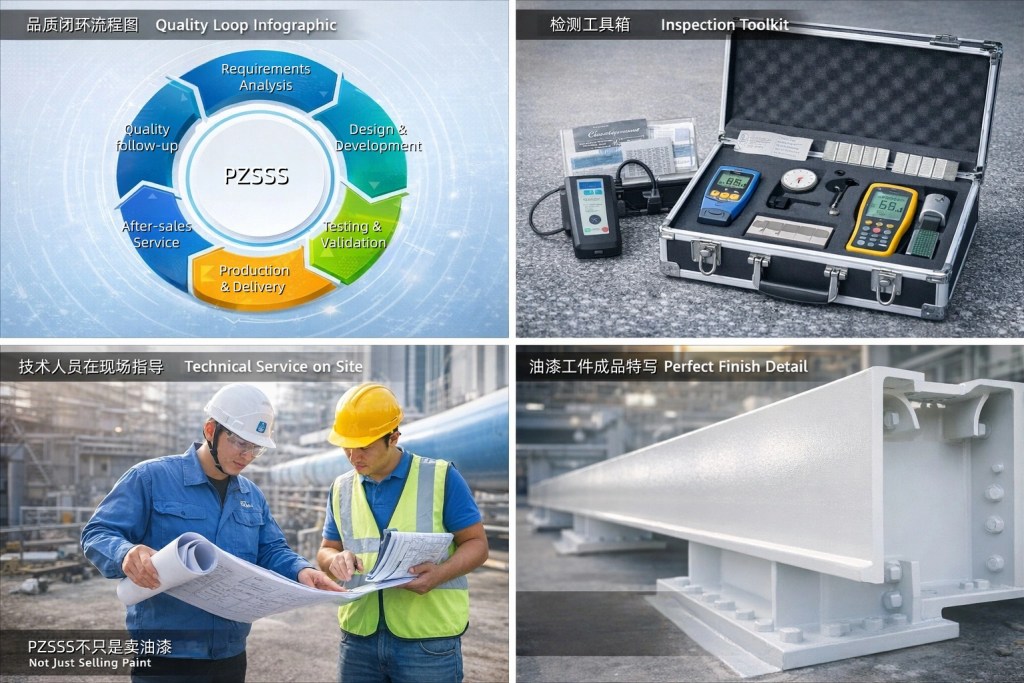
As an industrial paint manufacturer, we provide a closed-loop quality model from initial requirement to final delivery:
1. Precise Requirement Profiling (Requirement Phase)
- Key Point: Assessing corrosive environment (C1-C5), substrate type, structure complexity, and expected service life.
- Goal: Avoid “one-size-fits-all” approaches; ensure every system is a “tailor-made” selection for the specific environment.
2. Inbound Quality Control (Product Phase)
- Key Point: Verifying COA (Certificate of Analysis), testing viscosity, fineness, and drying times upon arrival.
- Goal: Ensure every batch is in optimal condition before the lid is even opened.

3. Surface Prep and Micro-Environment Monitoring (Prep Phase)
- Key Point: Blasting grade (Sa 2.5/St 3), surface profile, substrate temperature, and dew point detection.
- Goal: Build the strongest “foundation” for the film, eliminating risks of cracking or blistering.
4. Standardized Application and Process Control (Execution Phase)
- Key Point: Controlling thinning ratios, air pressure, real-time Wet Film Thickness (WFT) monitoring, and recoat intervals.
- Goal: Minimize the impact of human error on the final quality.
5. Final Inspection and Documentation (Delivery Phase)
- Key Point: Dry Film Thickness (DFT) testing, adhesion tests (Pull-off/Cross-hatch), and color consistency evaluation.
- Goal: Create a “Digital Identity” for every project, ensuring total quality traceability.


Conclusion: Industrial coating is a systematic engineering feat. From Day 1 to Day 60, our mission remains the same: Professional coating is about more than protecting metal—it’s about protecting investment value. Building a quality loop is the only way toward high-end manufacturing excellence.


You must be logged in to post a comment.